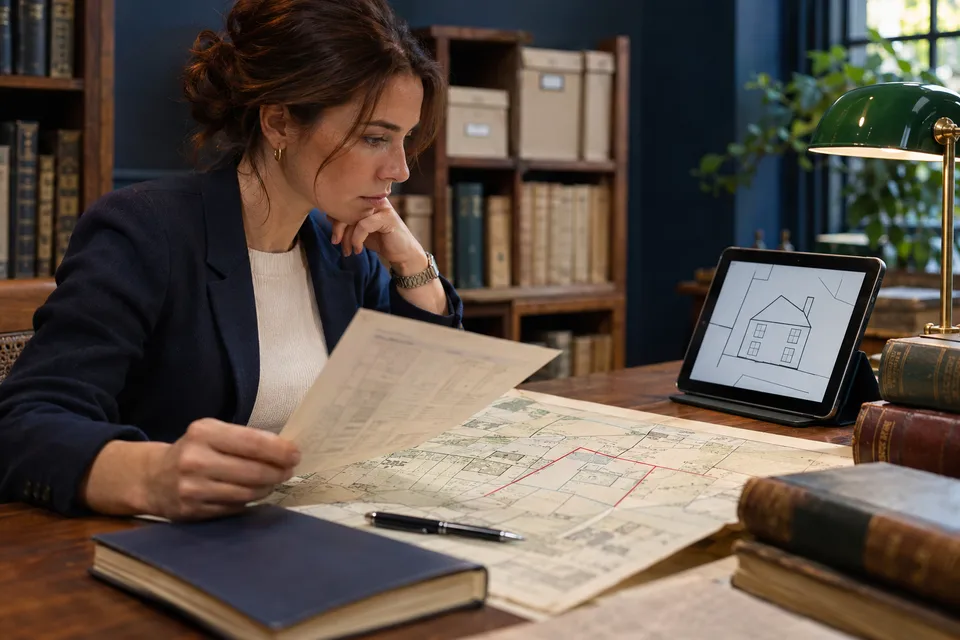
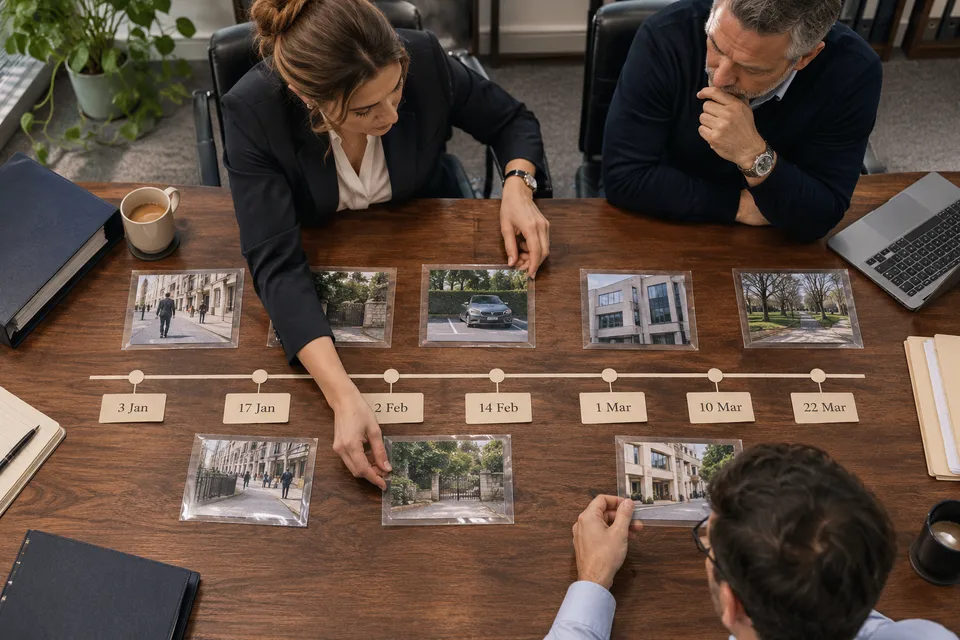
A private investigator helps build a civil litigation evidence timeline by turning scattered records, witness accounts and lawful observations into a dated sequence that shows what happened, what supports each event, and which questions remain unresolved. The result should be a traceable working chronology, not a selective story designed to favour one side. Solicitors can use it to assess allegations, prepare witness evidence, identify disclosure needs and decide where further investigation may actually help.
At Trojan Investigations , we distinguish a chronology from proof. A timeline entry only becomes valuable when the reader can find the source, understand whether its date is reliable and see any conflicting evidence. We work to the client’s specified legal purpose and the solicitor’s instructions rather than claiming that our report decides what a court must accept.
What Does a Good Civil Litigation Timeline Contain?
A useful litigation chronology is a structured index of relevant events, evidence and uncertainty. It should make it easy to test allegations rather than merely read them in order.
- Date and, where reliably known, time and time zone of each event.
- An objective description of what happened or was reported to have happened.
- A unique reference to the supporting document, image, log or witness account.
- The identity and source of the source, where lawfully recordable.
- A distinction between observed fact, reported statement and inference.
- Notes on contradictions, missing documents and disputed timing.
- Relevance to the legal issue and any follow-up verification required.
Chronology Is Not the Same as a Witness Statement
A chronology helps organise and test material. A witness statement is evidence attributed to a witness and must follow the applicable procedural requirements. In England and Wales, CPR Part 32 and Practice Direction 32 address witness evidence and its format. They require witnesses to distinguish personal knowledge from information or belief and identify the source where appropriate. An investigator should not silently turn another person’s recollection into a sworn-looking assertion.
A solicitor may use the chronology when drafting pleadings or planning witness interviews, but the legal team decides which evidence is relevant, how it should be disclosed and what final statement a witness can properly confirm. The rules differ in Scotland and Northern Ireland, and family or criminal proceedings have other frameworks.

The First Step Is to Identify the Issues That Matter
A timeline with hundreds of entries is not automatically helpful. Before collection starts, the legal team should identify the disputed issues: when notice was given, who authorised a transaction, what a supplier promised, when a defect was discovered, whether a payment followed a particular request or when an individual had access to relevant information.
We work backwards from those issues to reasonable evidence categories and date ranges. Our legal and litigation support focuses on documenting the factual route to an answer, while legal advisers decide the legal tests, limitation questions and disclosure obligations.
| Date or interval | Proposed timeline entry | Source and verification note |
|---|---|---|
| 3 March, year unspecified | Order accepted with stated delivery date | Original order confirmation; inspect full message headers and contract version |
| 7 March, year unspecified | Supplier reports dispatch | Supplier email; dispatch itself not independently verified |
| 9–10 March, estimated | Client reports goods did not arrive | Client account; require stock and carrier records |
| 11 March, year unspecified | Carrier scan reports delivery | Carrier system export; clarify location, recipient and time zone |
| 13 March, year unspecified | Client raises non-delivery complaint | Original support ticket with creation timestamp |
| Still unresolved | Who actually received goods and when | Delivery image or witness record may be needed |
These are illustrative events, not a real case or an assertion about any supplier. The point is that the timeline records both the allegation and the potentially contradictory entry rather than choosing one and hiding the other.
Preserve Originals Before Sorting Them
Emails, photographs, contracts, device exports, chat messages, call logs and accounting records can lose context when copied into a slide deck or pasted as screenshots. The original form often contains headers, creation data, sender fields or other properties that may matter later. Make working copies for review but do not overwrite the source files to make them easier to read.
Where litigation is contemplated, document preservation should begin promptly. Practice Direction 31B addresses preservation and electronic disclosure in cases to which it applies; Practice Direction 57AD sets detailed duties for Business and Property Courts disclosure and includes native-format/metadata considerations. The correct regime and search work covered are for the solicitors to determine, not something automatically identical in every civil case.
A Timeline Does Not Replace Disclosure Duties
Potentially adverse documents must not be removed simply because they weaken the client’s position. Relevance, privilege, disclosure and the work covered of electronic searches are legal questions. A private investigator should preserve and flag material for solicitor review rather than decide unilaterally what the other side should never see.
How We Establish Dates and Time Zones
Documents can carry different dates: when an email was drafted, sent or received; when a file was created, last modified or uploaded; when a server logged an event; or when a user took a screenshot. These are not interchangeable. A PDF creation timestamp does not necessarily date the underlying contract, and an image’s modified date may reflect harmless editing or transfer.
Where sources cross time zones, we record the original time zone and any conversion method. When no reliable minute is available, the entry should be "morning", "between these dates" or "date not independently verified" rather than fabricated precision. An explicit uncertainty can be more useful in court preparation than an apparently exact but unsupported timestamp.
What Happens When Two Records Contradict Each Other?
A supplier might state that an item was posted on Monday while a warehouse log first records it on Tuesday. A witness may remember an afternoon meeting that a calendar entry scheduled for the morning. Such inconsistencies do not necessarily mean anybody is dishonest. They can arise from delayed recording, separate time zones, shared devices, mistaken recollection or revised documents.
We preserve both versions, identify when each source was produced, and recommend targeted checks. A strong chronology gives the solicitor a map of disputes and reasons for uncertainty. It does not hide a conflicting date or transform one contested account into an objective fact.

Separating Direct Observation from Hearsay and Inference
An investigator who personally observes a vehicle arriving at a premises can record that observation, time, location and conditions. A witness who says the vehicle arrived earlier provides a different category of information. A conclusion that the driver was meeting a particular person may be an inference requiring separate evidence. Those distinctions should appear in the source record and the timeline.
Civil courts may consider hearsay under applicable rules, but admissibility and weight are not the same thing. CPR Part 33 addresses hearsay notices and requirements in England and Wales. The solicitor should decide whether a witness statement, formal notice, additional corroboration or a different presentation is needed.
Organising Photographs, Video and Relevant Surveillance
When lawful surveillance is relevant to a civil issue, the operative’s observation notes should identify actual times and limitations, with source footage kept intact. An edited excerpt should be traceable to the original recording. The report must not imply uninterrupted observation when the operative lost sight of a person or when a camera did not cover the full incident.
Our surveillance services are used only where a legitimate, proportionate factual question warrants them. A chronology built from public-source documents and client records may answer the question without needing any surveillance at all.
A Source Register Makes the Chronology Auditable
Evidence Register Fields Worth Preserving
- Unique source identifier that matches the chronology entry and report.
- File name or document description, including version if applicable.
- Original custodian or person who supplied the material.
- How and when the file or record was obtained lawfully.
- Original date/time fields and stated time zone, if available.
- Location of the unaltered original and secure working copies.
- Any integrity or transfer notes relevant to later authentication.
- Relevant passages or page numbers without deleting the full context.
- Known limitations, redactions, missing attachments or disputed authenticity.
- Whether the legal team has flagged privilege or another restriction.
When Can Digital Forensics Help?
Specialist examination may be justified where a file’s authorship, modification history or integrity is genuinely contested. It should be undertaken with appropriate authority and a proper handling record. An investigator cannot assume that a company employee’s personal device can be examined without a legal basis, or that a recovered fragment proves a complete conversation.
A forensic tool may establish technical information about a file or device; the commercial or legal meaning of that information is a separate question. We favour limited, question-driven analysis rather than collecting entire private devices as an automatic response to a civil dispute.
How the Timeline Supports Client Decisions Before Proceedings
A well-constructed chronology can expose that a claim depends on one uncorroborated recollection, or that a key email was sent after the decision it is said to explain. It can show which witness should be contacted, which third-party document may be worth seeking through the correct legal process and which issues are already supported by contemporary records.
The pre-action framework in England and Wales encourages proportionate exchange of information to understand and narrow disputes. That does not permit fishing expeditions or unlimited surveillance. We coordinate relevant fact-finding through business investigations when the dispute concerns contracts, misconduct or commercial loss.
Five Stages in Building a Litigation Chronology
1. Define Contested Facts
Agree relevant issues, jurisdictions, dates and report purpose with the solicitor.
2. Secure Source Records
Preserve lawfully held original documents, witness material and event logs before altering or summarising them.
3. Build a Neutral Event Register
Record what each source says, exact or estimated date, source and contradictory evidence.
4. Test Gaps and Competing Explanations
Target further lawful enquiries only where they could materially affect an issue or decision.
5. Deliver a Referenced Timeline
Provide the chronology, source index, limitations and unresolved questions in a format suitable for solicitor review.
How to Keep a Chronology Useful as New Evidence Arrives
New documents should be added as dated revisions, not silently inserted into an old report. A version history can record when the entry changed, what source prompted it and whether the alteration affects an earlier conclusion. If an old entry proves wrong, retain the correction trail rather than erasing the earlier mistake without explanation.
For lengthy proceedings, it is worth maintaining separate fields for event date and discovery date. A document discovered in November may describe an event in April; sorting it only by discovery date would misstate the sequence. The final reader should be able to follow both how the underlying events unfolded and how the evidence was collected.
Missing Attachments and Linked Documents Can Change the Meaning
An email may say a contract was approved, but the attachment could contain an earlier draft or an exception that substantially changes the position. A spreadsheet entry may reference a supporting invoice that has not yet been provided. The chronology should flag these missing components, identify which version is being discussed and avoid assuming that the displayed document represents the complete transaction. If the source is incomplete, the entry should say so clearly.
It is also important to distinguish records created during the events from summaries written months later. A contemporaneous system log may help establish an action time, but it might not explain the reason for the action. A retrospective witness account may supply that context while being less reliable about exact minutes. Comparing the strengths and weaknesses of both sources helps the solicitor avoid giving one type of evidence unwarranted authority.
How Should Sensitive, Privileged or Third-Party Information Be Handled?
Civil case files sometimes contain employee details, customer information, legal advice or sensitive personal data unrelated to the dispute. A timeline should not reproduce all of it simply because it appears in a relevant document. Mark source restrictions for the solicitor, limit working access and use appropriate secure channels. Where an excerpt can establish the event without unnecessary personal details, the legal team can determine whether redaction or a restricted version is proper.
Legal professional privilege and the duties of disclosure need careful handling. An investigator should never independently decide to disclose privileged advice, destroy an awkward message or edit an original record to simplify a story. If a document raises confidentiality or privilege questions, the investigator records its existence and refers the issue to the instructing solicitor before further circulation.
What Makes a Chronology Suitable for Solicitor Review?
It needs consistent event labels, searchable references, source source, realistic dates and unambiguous confidence statements. Unsupported adjectives such as "deliberately", "fraudulently" or "obviously" should not replace factual description. Where motive or intent is legally important, it must be supported by material the legal team can assess.
A clear document should also explain who assembled it, which date conventions were used and what lies outside the instruction. That level of transparency helps the lawyer decide whether an event warrants a witness statement, a disclosure request, an expert or no further work.
A Chronology Is Valuable Even When It Weakens an Assumption
Identifying a missing record, a mistaken date or a document inconsistent with the client’s account early can prevent litigation strategy being built on an error. A neutral timeline supports better decisions than a persuasive but incomplete narrative.
Before You Commission a Litigation Timeline
Ask the solicitor which issues need evidential support, the relevant procedural regime, document-preservation steps already taken and the intended use of the chronology. Provide only lawfully held documents and identify any material subject to privilege or special confidentiality restrictions. Agree work covered and likely costs before additional fact-finding begins.
To discuss a well-work coveredd evidence chronology, book a confidential consultation with Trojan Investigations . We can assess whether the missing facts can be clarified through appropriate enquiries, without promising that a timeline alone will win a case.
Frequently Asked Questions About Civil Litigation Evidence Timelines
UK answers on chronologies, emails, witness accounts, metadata, CPR evidence rules, preservation and solicitor-led reporting.
What Is a Civil Litigation Evidence Timeline?
It is a dated record of events linked to identifiable sources. It should show what happened or is alleged, when, the evidence supporting each entry and any contradictions or gaps.
Can a Private Investigator Prepare a Timeline for My Solicitor?
Yes, for a lawful, defined factual enquiry. The investigator may compile and test a chronology, while the solicitor controls pleadings, disclosure duties and what ultimately goes before the court.
Is an Evidence Timeline the Same as a Witness Statement?
No. A chronology is usually an organising and analysis tool. A witness statement presents a witness’s own evidence and must satisfy the applicable procedural rules and statement-of-truth requirements.
Can Emails and WhatsApp Messages Be Added to a Chronology?
Yes, if lawfully held and relevant. Preserve original material and conversation context, and distinguish displayed dates from independently verified timing.
How Should Investigators Handle Contradictory Evidence?
Record both accounts with sources and dates. Explain uncertainty, preserve contrary material and investigate significant differences instead of deleting whichever version weakens the client’s case.
Do Screenshots Count as Evidence of When Something Happened?
They can help, but a screenshot may show capture time rather than creation time, can omit context and may be edited. Original records and source are preferable where available.
Can the Timeline Include Surveillance Observations?
Potentially, where surveillance itself is lawful, necessary and proportionate. Notes should identify the actual observation window, interruptions and original footage without implying continuous coverage.
What If There Is No Exact Date for an Event?
Use a clearly marked estimate or interval and explain its source. False precision can make a chronology misleading and harder to defend.
Who Decides What Evidence Is Disclosable?
The party and its legal representatives, applying the relevant court rules and orders. A private investigator should preserve and flag potentially relevant material rather than make final legal disclosure decisions.
What Are Cpr Part 32 and Practice Direction 32?
They govern important aspects of witness evidence in civil proceedings in England and Wales, including witness statements, exhibits and statements of truth.
Does Cpr Practice Direction 57ad Apply to Every Civil Claim?
No. It is a specialised disclosure regime for relevant Business and Property Courts proceedings. The solicitor must identify the applicable rules for the actual claim.
Can a Chronology Help Before a Claim Is Issued?
Yes. It may identify evidence gaps, clarify which issues are disputed and assist proportionate pre-action decision-making. It is not a licence to collect unrelated private information.
Will a Chronology Guarantee the Court Accepts the Evidence?
No. The court controls admission and weight, and the legal team must comply with relevant rules. A transparent chronology improves organisation but does not create admissibility automatically.
What Should I Give an Investigator to Build a Timeline?
Provide the case question, key dates, relevant contracts, complete messages, business logs, witness details lawfully held and the solicitor’s instructions about format and deadlines.
How Long Does a Litigation Evidence Timeline Take?
It depends on document volume, consistency, missing records and disputed events. A work coveredd preliminary chronology can identify whether more work is justified before wider enquiries begin.
Not Sure Where to Start?
Tell us what happened and what you need to establish. We’ll discuss the options before you decide.
BOOK A FREE CONSULTATION