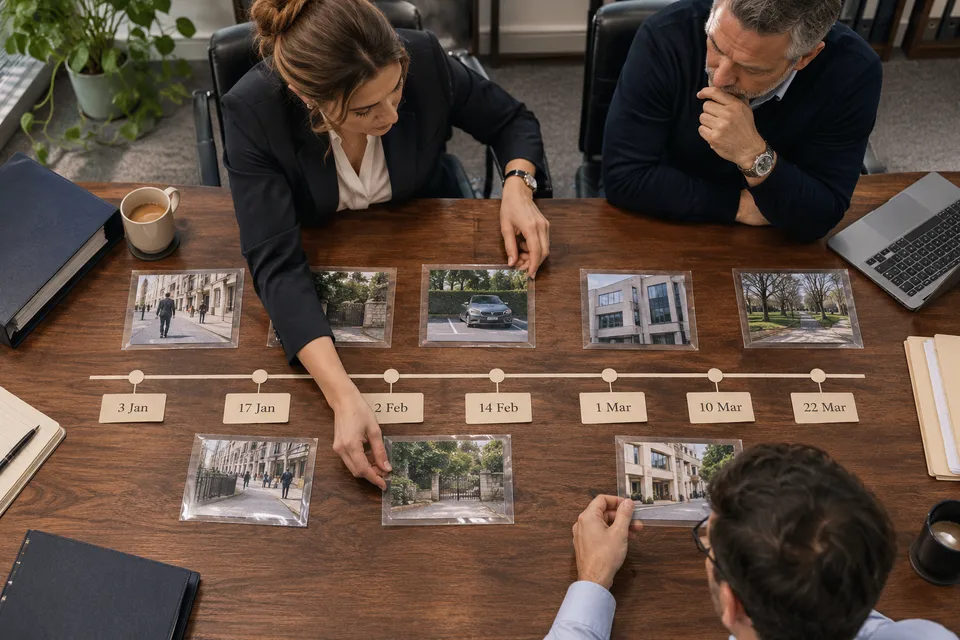
Private investigators help solicitors trace witnesses by turning incomplete identifiers into a verified current lead, documenting the search and, where appropriate, making lawful contact without pressuring the witness about what they should say. The investigator's role is to identify and locate the correct person, preserve the search trail and report the result. The solicitor or court controls the legal process for statements, summonses and use of evidence.
At Trojan Investigations , witness tracing is treated as litigation support rather than a simple address lookup. The key questions are whether the person has been correctly identified, whether the address is current, whether disclosure is appropriate, whether there are safeguarding concerns and what the legal team actually needs next.
How Can a Private Investigator Help Trace a Witness?
A solicitor may instruct an investigator to:
- confirm the witness's full identity from partial or historic information;
- check former names, aliases, employment or business links;
- research lawful address and public-record information;
- distinguish between people with similar names;
- verify whether a discovered address appears current before it is used;
- make proportionate field enquiries where desk-based information is insufficient;
- attempt neutral contact where the instruction permits it;
- record unsuccessful steps as well as successful ones;
- identify safeguarding, privacy or location-disclosure concerns; and
- provide a factual report to the instructing solicitor.
Tracing a witness does not give a private investigator power to compel attendance or dictate evidence. Those are separate legal questions.
CPR 32.4 defines a witness statement as a signed written statement containing evidence the person would be allowed to give orally. CPR 34.2 provides for a court-issued witness summons requiring attendance or production of documents. 7 days is the general minimum service period for a binding witness summons before the required attendance date, subject to the court's power to direct otherwise.Why Witness Tracing Is More Than Finding an Address
The wrong John Smith at a correct-looking postcode is not a successful trace. Litigation work needs identity confidence. We compare dates, former addresses, occupations, company roles, known associates and the chronology supplied by the solicitor so that a current lead can be tied to the intended witness rather than a namesake.
The report should explain which identifiers matched and which did not. If identity remains uncertain, the investigator should say so instead of presenting a probable match as a confirmed witness.
| Information supplied | How it helps | Risk if missing |
|---|---|---|
| Full name and former names | Narrows public records and avoids false matches | Common names can produce several plausible people |
| Last known address | Creates a geographic and chronological starting point | Old occupancy can be mistaken for current residence |
| Date or approximate year of birth | Helps distinguish people with the same name | Identity confidence may remain limited |
| Employer or occupation | Connects historic and current records | Employment may have changed or be non-public |
| Case relationship | Explains where the witness fits in the events | An investigator may search too broadly |
| Deadline | Controls urgency and method | Late tracing can leave insufficient time for statements or service |

Start with the Litigation Objective
A solicitor may need a witness for several different reasons: to take a voluntary statement, clarify an event, identify documents, support settlement discussions or attend a hearing. Those objectives are not interchangeable. The tracing plan should therefore begin with the next legal step, not with an open-ended request to find everything possible about the person.
Our legal and litigation support can be work coveredd around the evidential question and deadline so that the search produces information in a form the legal team can actually use.
Reasonable Steps Matter When an Address Is Uncertain
Civil Procedure Rule 6.9 is important where a claimant has reason to believe that an individual's last known address is no longer current. In that situation, the rule requires reasonable steps to ascertain the current residence or place of business before relying on the service provisions that follow.
A professional trace report can document what was checked, what was found and why a current address was considered sufficiently supported. The court, not the investigator, decides procedural questions about valid service and any application for alternative service.
Tracing Is Not the Same as Compelling a Witness
Under CPR Part 34, a witness summons is issued by the court and can require a witness to attend or produce documents. A private investigator has no equivalent coercive power. The investigator may locate or contact a person; the solicitor decides whether a formal court route is needed.
Witness Contact Must Remain Neutral
Where contact is authorised, the investigator should identify the purpose honestly and avoid coaching, threatening or pressuring the witness. A reluctant witness is not automatically an adverse witness, and an investigator should not suggest what the person ought to remember or how their evidence should be framed.
If the witness is willing to assist, the legal team can determine how any statement is taken. CPR Part 32 and Practice Direction 32 govern formal witness statements in civil proceedings, including the requirement that a statement be in the witness's own words where practicable and verified by a statement of truth.
Some Locations Should Not Simply Be Disclosed
A trace can raise safeguarding issues. A witness may be in a refuge, at a protected address, vulnerable to domestic abuse or intentionally withholding location for safety. The fact that an address has been found does not automatically mean it should be handed to every interested person.
Family Procedure Rule 6 specifically protects refuge identifying details in relevant service circumstances. More broadly, an investigator should assess the instruction and disclose through the solicitor in a controlled way where safety or privacy concerns arise.
Do Not Contact Relatives Repeatedly to Force a Response
Persistent contact with relatives, neighbours or the witness can become intrusive and can contaminate the evidence. The purpose is to locate and, where appropriate, invite contact - not to create pressure around the litigation.

How Public Records Support a Trace
Public and lawfully available sources can provide address history, company links, professional information and other identifiers. Each source has limits. A director's service address may not be a residential address, an electoral or commercial record can be historic, and a social profile may be stale or false.
We therefore corroborate. In personal matters, personal investigation services may help where the witness is an individual connected to a family or private dispute. For commercial litigation, business investigation services may add business identity and corporate-context checks.
What a Solicitor Should Expect in the Trace Report
A Useful Witness Trace Report Should Record
- the identifiers supplied at instruction;
- the work covered and purpose of the trace;
- which sources or enquiry categories were used;
- current and historic address findings;
- why the investigator believes the result relates to the intended person;
- any conflicting information or uncertainty;
- field or contact enquiries carried out;
- whether direct contact was achieved;
- any safeguarding or disclosure restriction identified; and
- the date of the findings so the solicitor knows how current they are.
How We Carry Out a Witness Trace
1. Identify the Witness Precisely
We start with name, former names, age or date of birth if lawfully available, former address, employer, case role and any known contact information.
2. Build the Address Chronology
Historic and current indicators are compared rather than treating one database entry as proof of residence.
3. Corroborate the Current Lead
We look for multiple indicators tying the same person to the same current location or business connection.
4. Use Proportionate Field Enquiry If Needed
Where desk-based sources are insufficient and the instruction justifies it, lawful local enquiries may be used to test whether a lead is current.
5. Report to the Solicitor
The result is delivered with limitations and supporting rationale so the legal team can decide on contact, statement, service or summons procedure.
How Quickly Can a Witness Be Traced?
Some traces resolve quickly when the solicitor supplies a full name, former address and distinctive identifiers. Others take longer because the witness has a common name, moved several times, changed surname, lives abroad or has deliberately reduced their public footprint.
Urgency should be explained at instruction. A court deadline may justify prioritised checks, but speed should not replace identity verification. Serving or contacting the wrong person can waste more time than a careful trace.
A Well-Documented Negative Result Is Still Useful
If a witness cannot presently be located, a report showing reasonable searches, conflicting leads and failed checks can help the solicitor decide whether to seek a court direction, use a witness summary where applicable or pursue another evidential route.
When to Instruct a Witness Trace
Earlier is usually better when a witness may be important. Memories fade, people move and court timetables can leave limited time for evidence preparation. A trace can also identify early that the witness is abroad, deceased, vulnerable or unwilling to engage, allowing the legal team to adjust strategy.
For a litigation-specific witness trace, you can book a confidential consultation . Supplying the case deadline and the precise evidential purpose at the outset helps us work covered the work proportionately.
Witness Tracing Is Different from Tracing a Defendant
A witness may have no dispute with either party and may simply possess relevant factual knowledge. That changes how contact should be approached. A defendant trace can be closely tied to service or enforcement; a witness trace should focus on identity, location, willingness to engage and the evidential role the solicitor has identified.
Neutrality is particularly important. The investigator should not make the witness feel that they are already aligned with one party or that they are expected to support a particular version of events.
Time Limits Can Change the Search Strategy
If a hearing is months away, a staged trace may be sensible: verify identity first, confirm current location and only then consider contact. If a witness statement deadline is imminent, the solicitor may need faster verification and a clear report of unsuccessful steps as well as positive findings.
The investigator should be told the real procedural deadline rather than a general request for urgency. That allows resources to be focused on the parts of the trace that actually affect the case.
Contact Attempts Should Be Recorded Carefully
Where direct contact is authorised, the report should record when and how contact was attempted, whether the correct person was reached and what the witness said about future communication. It should not include unnecessary personal detail or persuasive language designed to secure cooperation.
If the witness asks to communicate only through the solicitor, that preference should be respected. If the witness does not want to engage voluntarily, the investigator should report that fact without escalating pressure.
Location Verification Can Be More Important Than Disclosure
In some cases the solicitor needs confidence that a witness is at a particular address, but does not need the address circulated widely. A controlled report can confirm the result to the instructing legal team while limiting unnecessary disclosure to the client or other parties.
This can be particularly important where the witness is vulnerable, has safety concerns or is connected to a sensitive family or criminal matter. Tracing should solve the evidential problem without creating a new privacy or safeguarding problem.
What If the Witness Is Deceased, Abroad or Incapacitated?
A trace may establish that the intended witness cannot be contacted in the ordinary way. Death, overseas residence, serious illness or incapacity can fundamentally change the legal team's options. The value of the trace is then in establishing the fact reliably and giving the solicitor enough information to consider an alternative evidential route.
Where a witness is abroad, local law and service or evidence-taking rules may also become relevant. International work should therefore be planned with the solicitor rather than treated as a domestic trace with a foreign address.
A Negative Trace Should Explain Why Confidence Could Not Be Reached
“Not found” can mean very different things. It may mean there are no reliable current records, several people fit the identifiers, the person has moved abroad, the available data is too old, or the investigator has located a possible address but cannot corroborate it sufficiently.
Those distinctions help the solicitor decide whether to provide more identifiers, instruct field enquiries, apply for a procedural direction or proceed using other evidence. A transparent negative result is more valuable than an overconfident address guess.
Witness Traces Should Be Updated If the Case Is Delayed
Litigation timetables change. A witness located early in proceedings may move before trial or before formal contact is required. Where a significant period has passed, the solicitor may need a proportionate re-verification rather than relying indefinitely on the original address.
The trace date and confidence level should therefore be obvious in the report. This allows the legal team to decide whether the result is still sufficiently current for the next procedural step.
Frequently Asked Questions About Tracing Witnesses for Solicitors
Answers about current-address tracing, witness contact, CPR requirements, witness summonses, privacy and litigation-support reporting.
What Does a Witness Trace Involve?
It involves identifying the correct person, checking lawful address and public-source information, corroborating a current lead and reporting the result with limitations to the instructing solicitor.
Can a Private Investigator Force a Witness to Speak?
No. A private investigator has no power to compel an interview or statement. Where compulsory attendance is needed, the solicitor may consider the court procedures for a witness summons.
What Is a Witness Summons?
Under CPR Part 34, it is a document issued by the court requiring a witness to attend to give evidence or produce documents. It is separate from the investigator's tracing work.
How Much Information Is Needed to Start a Witness Trace?
A full name and former address are useful, but date of birth, former names, employer, telephone number, case relationship and other identifiers can significantly reduce false matches.
Can You Trace a Witness from an Old Address?
Often an old address is a strong starting point because it can connect historic records and later movement. It does not by itself prove a current residence.
Can a Solicitor Serve Papers at the Last Known Address?
The answer depends on the relevant procedural rules and facts. CPR 6.9 requires reasonable steps to ascertain a current address where there is reason to believe the last known address is no longer current.
Can You Contact the Witness After Finding Them?
Where the instruction, legal context and safeguarding assessment permit it, neutral contact may be attempted. The witness should not be pressured or coached.
Can a Witness Refuse to Give a Voluntary Statement?
Yes. A person can decline voluntary engagement. Any formal power to require attendance or documents comes from the court process, not from a private investigator.
Can You Trace Witnesses Abroad?
Some international traces are possible, but local law, data-transfer rules, language, records and court procedure can affect the method and timescale.
What If the Witness Has Changed Surname?
Former names, addresses, employment, family links and other lawful identifiers can help connect records across a name change. The report should explain the basis for the match.
Will You Disclose a Protected or Refuge Address?
Not automatically. Safety and procedural protections matter. Where disclosure could put someone at risk, the result should be handled through the solicitor and relevant court process.
Can Social Media Be Used to Find a Witness?
Publicly available social information can provide leads, but it should be corroborated. A profile alone may be outdated, copied or belong to someone with the same name.
How Long Does a Witness Trace Take?
It varies from a relatively straightforward trace to a more complex multi-stage enquiry. Common names, international movement and weak identifiers can extend the work.
What If the Witness Cannot Be Found?
The investigator should report the searches completed, unresolved leads and limitations. That may help the solicitor decide on alternative evidence or a procedural application.
What Should a Solicitor Send with the Instruction?
Send the witness identifiers, case context, last known address, relevant documents, deadline, the purpose of the trace and whether direct contact or only location verification is required.
Not Sure Where to Start?
Tell us what happened and what you need to establish. We’ll discuss the options before you decide.
BOOK A FREE CONSULTATION