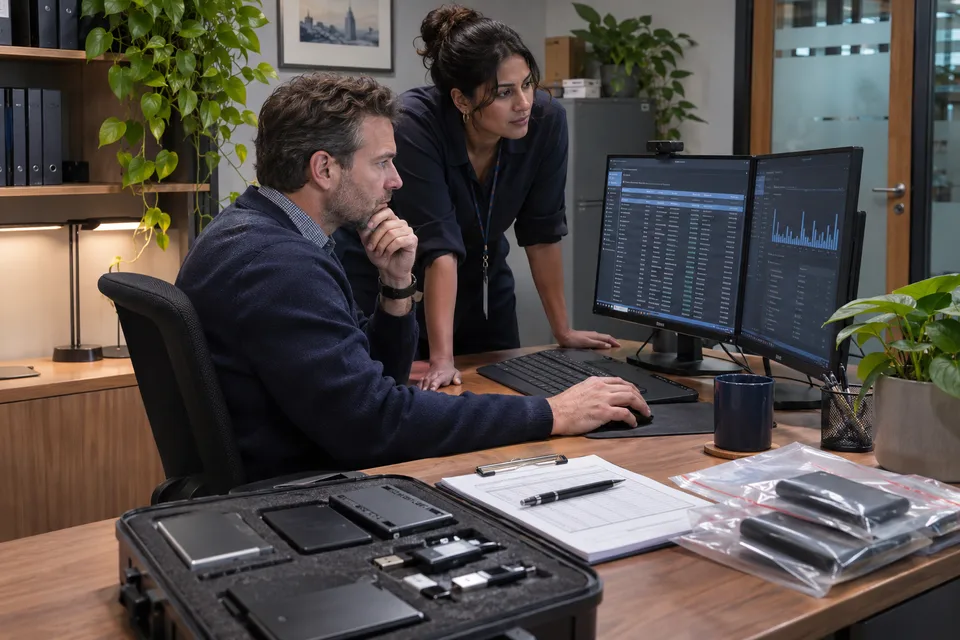

A workplace theft investigation should establish facts, not start from an assumption of guilt. When stock, cash, equipment, data or company resources go missing, employers need to preserve evidence quickly while still following a fair process. That means defining the allegation, securing relevant records, considering evidence that supports and contradicts the suspicion, interviewing people objectively and using monitoring only where it is lawful, necessary and proportionate.
At Trojan Investigations , we support employers with evidence-led workplace and corporate enquiries. Our role is to help establish what happened, who may have been involved and what the evidence actually shows. The employer, its HR advisers, solicitors, insurers or police then decide what action should follow.
Originally published: 6th June 2026 | Updated: 7th September 2026
How Should a Workplace Theft Investigation Be Handled?
Start by protecting evidence and business assets, then investigate fairly. Acas says a workplace investigation should gather evidence from all sides, find out whether there is a case to answer and help the employer decide what should happen next. The investigator should not set out to prove guilt. Where covert monitoring is considered, the ICO says it is unlikely to be justified in ordinary circumstances and should be exceptional, targeted, time-limited and supported by a DPIA.
What Counts as Workplace Theft?
Workplace theft can involve tangible property, money, services, information or misuse of company systems. The legal classification depends on the facts. A missing tool may raise a straightforward property-theft question; manipulated invoices may indicate fraud; copying confidential files may involve contractual, data-protection, intellectual-property or computer-misuse issues as well as disciplinary concerns.
| Concern | Useful evidence | Important caution |
|---|---|---|
| Cash or till shortages | Till logs, refunds, shift records, CCTV, reconciliations | A shortage does not identify the person responsible |
| Stock or equipment loss | Inventory records, access logs, dispatch records, CCTV, vehicle movements | Errors, damage and supplier discrepancies must be excluded |
| Expense or procurement fraud | Invoices, approvals, supplier data, emails, payment records | Financial anomalies require context and authorisation checks |
| Time or mileage fraud | Timesheets, job records, lawful vehicle data, diaries | Location evidence may not prove who was driving or working |
| Data or IP theft | Access logs, file events, device images, permissions, exit activity | Preserve systems before altering or deleting evidence |

Why Employers Should Avoid Immediate Accusations
Missing property can create understandable pressure to act quickly, but an early accusation can distort the investigation and damage trust. Acas’s current guidance, updated in June 2026, says an investigator should be fair and objective, obtain as much information as is reasonable, consider evidence from both sides and not try to prove guilt.
There may be innocent explanations for apparent red flags. Stock may have been booked incorrectly, an authorised manager may have removed equipment, a refund may have been processed under the wrong user account or several people may share a workspace or device. A strong investigation tests alternatives before reaching a conclusion.
Suspicion Is a Reason to Investigate — Not a Finding
Behaviours such as working late, resisting annual leave, making unusual purchases or appearing nervous may be relevant context, but none proves theft. Decisions should be based on evidence connected to the alleged conduct, not stereotypes about what a dishonest employee supposedly looks like.
Step 1: Define the Allegation and the Investigation Question
A useful terms-of-reference document should set out what is suspected, the time period, the assets or records affected and what the investigator is being asked to establish. Vague instructions such as “find out what this employee has been doing” encourage unnecessary intrusion and make it harder to demonstrate proportionality.
For employers seeking external support, our business investigations are work coveredd around a defined factual objective. Examples include identifying how stock leaves a site, establishing whether an expense claim matches documented activity, or testing whether confidential information is being transferred to an outside party.
Step 2: Preserve Evidence Before It Disappears
Acas specifically highlights time-sensitive evidence such as CCTV that may be overwritten and staff who may soon be unavailable. In a theft investigation, preservation can include saving relevant CCTV segments, securing access-control exports, retaining till and audit logs, preserving email or collaboration records that the employer is entitled to use, documenting stock counts and ensuring relevant company devices are not wiped.
Preservation should be controlled. Copying entire mailboxes, personal devices or unrelated employee records simply because they might contain something useful can create data-protection and confidentiality problems. The principle is to retain what is reasonably connected to the investigation.
Step 3: Separate Business Security from Employee Monitoring
An employer may already operate CCTV, access control, fraud monitoring or vehicle systems for legitimate security and operational purposes. Using those records in an investigation can be appropriate, but the original purpose, employee privacy information, lawful basis and proportionality still matter.
The ICO states that data protection law does not prohibit worker monitoring, but employers must identify a lawful basis, ensure fairness, define the purpose and use the least intrusive method that can achieve it. Where monitoring is likely to create high risks, a Data Protection Impact Assessment should be considered or completed as required.

Can Covert Monitoring Be Used to Investigate Theft?
Sometimes, but it should not be treated as the default. The ICO says covert worker monitoring is unlikely to be justified in most normal circumstances. It may be considered exceptionally where there are grounds for suspecting criminal activity or equivalent gross misconduct and telling workers would prejudice prevention or detection.
Where an employer considers covert monitoring, the ICO says senior management should authorise it, a DPIA must be carried out, monitoring should be tightly targeted, limited to the shortest possible period and stopped when the investigation is complete. Covert audio or video should not be used in areas where workers reasonably expect privacy, such as toilets or changing rooms.
If a private investigator is used, the ICO specifically says the employer should have a contract requiring the investigator to collect information in a way that satisfies the employer’s data-protection obligations. Our surveillance services are therefore planned around the client’s lawful purpose rather than a blanket request to monitor staff.
Covert Does Not Mean Unregulated
An employer cannot avoid data-protection duties simply because it believes theft is occurring. Even where covert monitoring is justified, purpose limitation, data minimisation, security, access control, retention and employee rights remain relevant.
Step 4: Review Documentary and Digital Evidence Objectively
Documents and system logs can establish sequence and access, but they need interpretation. A username may show which account performed an action; it does not automatically prove who was physically at the keyboard. CCTV may show someone carrying a box; it may not show what the box contained or whether removal was authorised.
Good practice is to build a chronology and record the source of each fact. We separate direct observations from inferences and identify gaps rather than filling them with assumptions. This makes the final report more useful to HR, legal advisers and decision-makers.
Step 5: Interview Witnesses and the Person Under Investigation
Acas says witnesses can provide important evidence through signed statements or investigation meetings. Where a meeting is held, notes should be taken and the witness should have an opportunity to review and sign them as accurate.
Interview questions should be open enough to obtain the person’s account and specific enough to test discrepancies. The investigator should not coach witnesses, threaten a preferred answer or present an allegation as already proven. Evidence that undermines the allegation should be recorded just as carefully as evidence that supports it.
Should an Employee Be Told They Are Being Investigated?
Acas says the employer or investigator should normally tell the worker as soon as the decision to investigate has been made, unless there is a concern that doing so could lead to evidence being tampered with or witnesses being influenced. That is a practical exception, not a licence for indefinite secrecy.
Employers should coordinate communications with HR or legal advisers where the allegation is serious. The investigation, disciplinary decision and any appeal should remain procedurally distinct where possible.
What About Searching an Employee or Their Belongings?
Private investigators do not have police search powers. Acas notes that workplace searches should be approached carefully and, where contractual policies permit a search, a refusal should not automatically be treated as proof of guilt. If a suspected criminal offence requires compulsory search powers, the police have wider statutory powers that private employers and investigators do not.
When Should the Police Be Involved?
Some workplace matters remain internal disciplinary issues; others may amount to suspected theft, fraud, computer misuse or another offence. Acas recognises that employers may need to decide whether to involve police and may sometimes continue an internal investigation while criminal proceedings are ongoing, provided they take care not to prejudice the criminal case.
Where police involvement is likely, preserving original evidence and keeping a clear audit trail becomes even more important. An employer should not alter devices, delete accounts or conduct aggressive interviews simply to “get a confession” before making a report.
What Standard Does an Internal Investigation Need to Meet?
An internal workplace investigation is not a criminal trial. Its purpose is usually to establish facts sufficiently for the employer to decide whether there is a disciplinary case to answer. If the matter proceeds, the employer should follow its own policy and the Acas Code of Practice as a minimum where applicable.
Our reports are factual. We can state what was observed, what records show, what a witness said and where accounts conflict. We do not decide criminal guilt and we do not replace the employer’s disciplinary decision-maker or solicitor.
Current Data Shows Why Strong Fraud Controls Matter
The Home Office Economic Crime Survey 2024 found that 27% of UK businesses with employees experienced fraud in the previous 12 months, equivalent to about 389,000 businesses. This is broader than employee theft and must not be presented as an insider-theft statistic, but it demonstrates the scale of economic-crime exposure facing employers. The most commonly reported fraud types in that survey included fake invoice fraud and mandate fraud.
The practical lesson is that controls should address both internal and external threats. Segregation of duties, supplier verification, access management, audit logs, whistleblowing routes and prompt investigation are stronger than relying on a single camera or hoping losses will stop.
27% of UK businesses with employees experienced fraud in the Home Office Economic Crime Survey 2024. 74% of business fraud victims in that survey experienced more than one incident. 16 was the mean number of fraud incidents among business victims, although the median was three.Preventing Workplace Theft Without Creating a Surveillance Culture
Prevention works best when controls are designed into the business. Clear asset registers, stock reconciliation, role-based access, dual approval for payments, documented write-offs, secure return of equipment at exit, prompt removal of unnecessary system access and well-publicised reporting channels can reduce opportunities for theft.
Monitoring should not become constant suspicion of everyone. The ICO warns that excessive monitoring can intrude into private life and undermine trust. Security controls should be proportionate to the risk and transparent unless a genuinely exceptional covert investigation is justified.
What a Good Investigation Report Should Contain
Acas provides investigation-plan and investigation-report templates. A useful report commonly records the terms of reference, chronology, evidence reviewed, witness material, facts established, conflicting evidence, limitations and findings. Recommendations should only be included where the investigator has actually been asked to make them.
For matters connected with litigation, insurance recovery or serious misconduct, our legal and litigation support can be coordinated with the client’s solicitor so that the investigation answers the factual questions that matter.
What If the Investigation Does Not Prove Theft?
A negative or inconclusive result can still be valuable. It may show that a stock-control process is weak, that several employees share credentials, that CCTV coverage is inadequate, that a suspected person could not have been present or that the loss is more consistent with administrative error than dishonesty.
A professional investigation should be capable of clearing a wrongly suspected employee as well as identifying misconduct. That is why evidence that contradicts the allegation should never be hidden from the final report.
1. Define
Set the allegation, period, assets and factual questions.
2. Preserve
Secure time-sensitive CCTV, logs, documents and devices lawfully.
3. Test
Review evidence for and against the allegation and identify alternatives.
4. Interview
Obtain fair accounts from relevant witnesses and the employee.
5. Report
Separate facts, inference, limitations and unresolved questions.
The Strongest Workplace Investigation Is Defensible Even If the Answer Is Not What the Employer Expected
Fairness, proportionality and a reliable audit trail protect the business as well as the employee. The objective is not to generate a predetermined outcome; it is to give the decision-maker a sound factual basis.
Need an Independent Workplace Theft Investigation?
We can assess the allegation, evidence already available and the least intrusive lawful route to establish the facts. Book a confidential consultation .
Frequently Asked Questions About Workplace Theft Investigations Explained
Clear answers on employee theft allegations, evidence, CCTV, covert monitoring, interviews, suspension, police involvement, disciplinary action, digital evidence and investigation timescales.
What Should an Employer Do First If Workplace Theft Is Suspected?
Secure business assets and preserve relevant evidence, then define the allegation and investigation work covered. Avoid accusing an employee before the facts have been investigated.
Does a Workplace Investigation Have to Prove Guilt?
No. Acas says the investigator should establish facts, gather evidence from both sides and determine whether there is a case to answer rather than trying to prove guilt.
Can an Employer Use CCTV in a Theft Investigation?
Potentially, if the footage was collected and used lawfully and its use is necessary and proportionate. The employer should also preserve relevant footage before routine deletion.
Can Covert Surveillance Be Used to Investigate Employee Theft?
Only in exceptional circumstances. ICO guidance says covert worker monitoring is unlikely to be justified in ordinary situations and should be senior-authorised, DPIA-supported, targeted and time-limited.
Can Hidden Cameras Be Placed in Toilets or Changing Rooms?
The ICO says covert audio or video monitoring should not be used in areas where workers reasonably expect privacy, such as toilets or changing rooms.
Should the Employee Be Told an Investigation Has Started?
Normally yes. Acas says they should generally be told as soon as the investigation begins unless there is a real risk of evidence tampering or witness interference.
Can a Private Investigator Search an Employee?
A private investigator has no police search power. Workplace searches depend on policy, contract and consent, and a refusal should not automatically be treated as guilt.
Can Digital Logs Prove Who Stole Something?
They can be important evidence, but a user account or device event may not prove who physically performed the action. Identity and context often require corroboration.
Can Witnesses Remain Anonymous?
Sometimes confidentiality can be protected, but anonymous evidence creates fairness and weight issues. Employers should take HR or legal advice and avoid promising absolute anonymity that cannot be maintained.
When Should Police Be Contacted?
Where the facts suggest a criminal offence, significant loss, safety concern or powers beyond the employer’s reach may be involved. Internal and criminal investigations should be coordinated carefully.
Can an Employee Be Suspended During the Investigation?
Suspension can be considered under the employer’s HR process where justified, but it should not be treated automatically as a punishment or proof of guilt.
How Long Should a Workplace Theft Investigation Take?
There is no universal duration. Acas says it should be completed as quickly as possible while remaining thorough and fair.
Can Investigation Evidence Support Disciplinary Action?
Yes. Fairly and lawfully gathered evidence can support an internal disciplinary process, but the employer should follow its own procedure and the Acas Code where applicable.
What If the Investigation Clears the Suspected Employee?
That is a valid outcome. The report should record evidence that undermines the allegation and may identify process weaknesses or alternative explanations for the loss.
What Should a Business Look for in an External Workplace Investigator?
Look for independence, relevant experience, clear terms, data-protection competence, proportionate methods, secure evidence handling and a willingness to report inconvenient as well as supportive findings.
Not Sure Where to Start?
Tell us what happened and what you need to establish. We’ll discuss the options before you decide.
BOOK A FREE CONSULTATION