A private investigator cannot lawfully “hack WhatsApp” or secretly read another person’s private chats simply because a client wants answers. WhatsApp personal messages and calls are protected by end-to-end encryption, and UK law does not give private investigators special powers to bypass passwords, clone accounts, intercept communications or access someone else’s device or cloud account without authority.
That does not make WhatsApp irrelevant to an investigation. Where a client already lawfully possesses messages, screenshots, exported chats, a device they are entitled to access, business records or other surrounding evidence, those materials can be preserved, verified and correlated with timelines, payments, public-source research, witness evidence or physical observations.
At Trojan Investigations , we treat WhatsApp as one potential evidence source within a wider investigation — not as a back door into another person’s private communications.
Originally published: 24th July 2026 | Updated: 7th September 2026
What Can a Private Investigator Actually Do with WhatsApp Evidence?
They can work with material the client is lawfully entitled to provide, preserve original context, compare messages with other evidence, investigate identities or businesses through lawful sources, document scam indicators and advise on further investigative steps. They cannot create lawful access where none exists by stealing credentials, scanning login QR codes without authority, installing spyware, secretly linking another device or intercepting messages in transit.
WhatsApp Encryption Changes the Investigation Question
WhatsApp states that personal messages, calls, media, voice messages and documents are protected with end-to-end encryption by default. In simple terms, the service is designed so that the sender and intended recipient hold the keys needed to read the content; WhatsApp says even it cannot read those personal messages in transit.
This means a legitimate investigation usually asks, “What lawful evidence exists around this communication?” rather than “How do we break the encryption?” The answer may lie in a participant’s own device, screenshots they retained, payment records, public profiles, company records, witness accounts or conduct that occurred away from WhatsApp.
| Scenario | Potentially legitimate approach | Not a legitimate PI method |
|---|---|---|
| Client received scam messages | Preserve original messages, number, profile details, links, payment evidence and timeline | Hack the sender’s account |
| Employee used WhatsApp for business misconduct | Review authorised company records/devices within policy and data-protection rules | Secretly access a personal account without authority |
| Relationship concern | Use lawfully supplied evidence plus public-source or physical investigation | Clone a partner’s account or add a linked device secretly |
| Deleted chat | Assess lawful backups or forensic options on an authorised device | Promise remote recovery from someone else’s phone |
| Court or dispute evidence | Preserve source, context, dates, participants and original files where possible | Present cropped screenshots as self-proving |

Can a Private Investigator Read Someone Else’s WhatsApp Messages?
Not without lawful access. Section 1 of the Computer Misuse Act 1990 makes unauthorised access to computer material an offence where the statutory elements are met. Using a password obtained without permission, bypassing device security, secretly adding a linked device or installing spyware can create serious legal problems.
The Investigatory Powers Act 2016 also regulates interception of communications. Section 3 makes intentional interception in the UK in the course of transmission without lawful authority an offence. Private investigators do not possess the interception warrants or statutory powers available to authorised public bodies.
“i Know the Passcode” Is Not the Same as “i Have Authority”
A client may know a partner’s password, have previously shared a tablet or be able to access an unattended device. That does not automatically give a professional investigator lawful authority to enter an account, link a new device or extract private communications. Access should be assessed by reference to ownership, permission, purpose and the applicable law.
What Evidence Can a Client Lawfully Provide?
If a person is a participant in a conversation, they may already possess messages sent directly to them. A business may also hold records generated through an authorised corporate device or approved work account. In those situations, the investigation can focus on preservation and verification rather than acquisition.
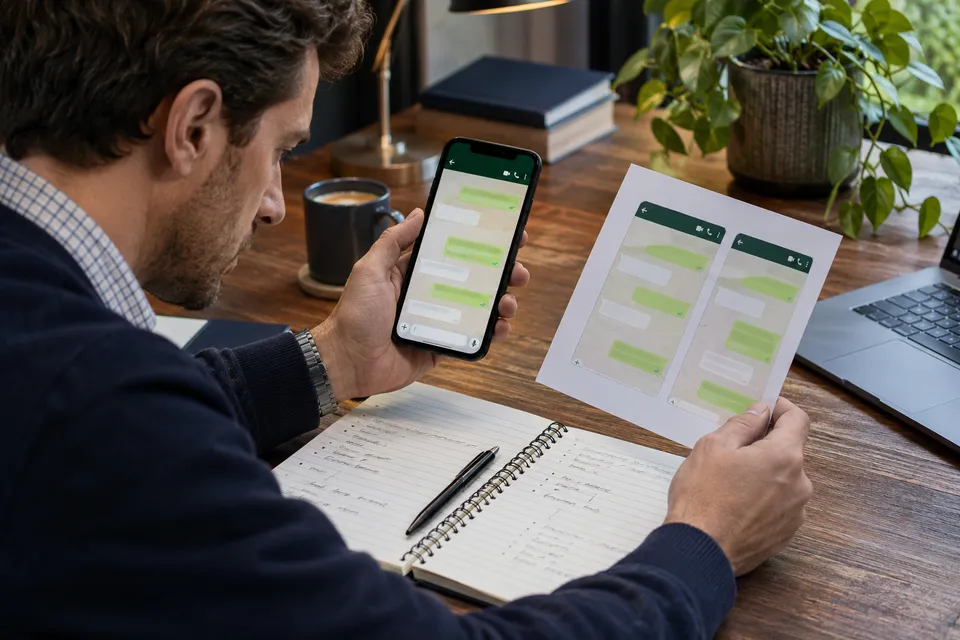
Useful material can include full-screen screenshots showing dates and contact identifiers, exported chats, original images or documents, voice notes lawfully received by the client, payment confirmations, URLs, account names and the device on which the material was received. The more complete the context, the easier it is to distinguish authentic evidence from edited or selectively presented material.
Why Screenshots Need Context
A screenshot is easy to create and easy to crop. It may be useful, but it should not be treated as automatically conclusive. The investigator should ask who captured it, when, from which device, whether the conversation before and after is available, whether a contact name could have been edited and whether the image file itself has been altered.
Where a screenshot is likely to matter in a legal dispute, preserve the original file and source device where lawful and practical. A transcription or retyped message loses valuable contextual information.
Can Deleted WhatsApp Messages Be Recovered?
Sometimes, but only in limited and lawful circumstances. WhatsApp explains that chats can be restored from the last successful backup associated with the user’s account, and it offers optional end-to-end encrypted backups protected by a passkey, password or 64-digit encryption key. WhatsApp also states that it cannot provide or reset the key for an encrypted backup that the user can no longer access.
A forensic examiner working on a device with the owner’s authority may sometimes identify remnants, backups or related artefacts, but success depends on the device, operating system, settings, overwrite activity, backup configuration and lawful access. No responsible investigator should promise guaranteed recovery from a third party’s phone.
What About Cloud Backups?
Backups are not a loophole. Access to another person’s Google Account, iCloud account or encrypted WhatsApp backup still requires lawful authority. End-to-end encrypted WhatsApp backups can be protected by a passkey, password or 64-digit key, and WhatsApp says neither it nor the backup provider can read the encrypted backup without the relevant secret.
If the account holder voluntarily provides an authorised backup or a solicitor secures evidence through an appropriate legal process, the position is different. But private investigators do not obtain a general right to someone’s cloud data because an investigation is commercially important.
Can a Private Investigator See Who Someone Is Messaging?
Not by secretly accessing WhatsApp. However, an investigation may establish surrounding facts: a person may meet an identified individual after a sequence of events, a business payment may correspond with a known contact, a public profile may connect a phone number to a trading identity, or a client may already possess messages sent by that person.
Our personal investigations focus on facts that can be lawfully established rather than attempting to reconstruct private communications by prohibited means.
WhatsApp in Workplace Investigations
WhatsApp can appear in investigations involving leaked documents, off-platform instructions, supplier collusion, harassment, theft or conflicts of interest. Employers should not assume that “work-related” content makes every personal message available to them.
If WhatsApp is used on company equipment or for authorised business communication, the employer should consider its policies, privacy information, lawful basis, necessity and proportionality. The ICO’s worker-monitoring guidance stresses that personal communications raise significant privacy concerns and that covert monitoring is exceptional.
For corporate cases, our business investigations can combine lawful company evidence with interviews, public-source research, financial chronology and other corroboration.
WhatsApp Scams and Fraud Investigations
Messaging platforms are also a major route for fraud and account targeting. The UK Government’s Fraud Strategy 2026–2029 says 53% of reported authorised push payment fraud cases in 2023 involved social-media, messaging or call platforms. That figure covers a broad group of platforms and should not be presented as a WhatsApp-only statistic.
The National Cyber Security Centre warned in 2026 about malicious targeting of messaging apps including WhatsApp and Signal. It highlighted tactics such as tricking users into sharing login or recovery codes, adding an attacker-controlled device to an account, impersonating trusted contacts and using malicious links or QR codes.
53% of reported APP fraud cases in 2023 involved social-media, messaging or call platforms, according to the UK Fraud Strategy 2026–2029. 2026 NCSC guidance warned high-risk users about malicious targeting of messaging apps, including WhatsApp. E2EE WhatsApp says personal messages and calls are protected by end-to-end encryption by default.What Should a Fraud Victim Preserve?
If you receive a suspicious WhatsApp message, preserve the evidence before blocking or deleting the conversation. Useful items include the full number, profile name and photo, the message thread, dates and times, links, QR codes, payment instructions, wallet addresses, bank details, voice notes and any documents or images supplied.
The Government’s Stop! Think Fraud guidance notes that fraudulent messages sent by WhatsApp, SMS or other messaging services often try to create urgency, direct victims to links or request personal data. Where money has been sent, contact the bank promptly and report the fraud through the current national reporting route.
Linked Devices Are a Security Issue, Not an Investigation Shortcut
WhatsApp allows users to link additional devices to an account. The NCSC’s 2026 guidance specifically advises users to review linked devices and remove or verify anything they do not recognise. An attacker may try to persuade a victim to scan a QR code or share a verification code so the attacker can add a device.
A private investigator should never use that same technique as a covert means of monitoring a target. If a client discovers an unknown linked device, that is potentially evidence of account compromise and should be preserved and addressed as a security incident.
Can WhatsApp Messages Be Used in Court?
They can be relevant evidence in civil, family, employment or criminal proceedings, but admissibility and weight depend on the circumstances. A court may consider authenticity, completeness, source, hearsay issues, relevance and how the material was obtained.
For litigation, our legal and litigation support focuses on preserving an audit trail and separating what a message proves from what the client believes it means. If evidence has been obtained unlawfully, that can create separate legal, procedural and credibility problems even if the content appears important.
Can Police or Other Authorities Obtain More Than a Private Investigator?
Yes. Public authorities may have statutory powers that private investigators do not. The legal framework around device and online-account extraction continues to evolve; for example, the Crime and Policing Act 2026 expanded safeguards and powers concerning voluntary access to online accounts for authorised persons in defined circumstances.
That should not be confused with private-sector authority. A private investigator cannot borrow police powers, issue a warrant or compel WhatsApp to disclose content.
What About Public WhatsApp Information?
Some WhatsApp-related information may be visible without entering a private chat, depending on the user’s settings and whether you are already an authorised contact. Profile names, photos, channel content or group information may sometimes be visible. Visibility does not remove the need to process personal data fairly and proportionately.
Investigators should also be alert to impersonation. A profile photo and display name do not prove who controls an account. Number history, independent contact details, payment identifiers and external corroboration may be required.
What a Lawful WhatsApp Investigation Can Establish
- Whether messages supplied by a client fit a wider timeline.
- Whether a number or claimed identity connects to a business or public digital footprint.
- Whether scam material matches known fraud patterns.
- Whether meetings, payments or public activity corroborate communications.
- Whether company records support an allegation of workplace misconduct.
- Whether the evidence is incomplete, inconsistent or incapable of proving the allegation.
The final point matters. A professional investigation should be able to say “this material does not prove what you think it proves” when that is the correct conclusion.
Do Not Destroy the Very Evidence You May Need
If WhatsApp forms part of a fraud, harassment, employment or legal dispute, avoid repeatedly forwarding, editing, re-saving or deleting the source material. Preserve originals where lawful and practical, document how they were obtained and seek legal or forensic advice before altering a device that may need examination.
Practical Security Steps After Suspected Account Compromise
The NCSC recommends steps such as not sharing verification codes, avoiding unexpected QR codes, enabling two-step verification and passkeys where available, checking linked devices and independently verifying unusual contacts. These are defensive security measures, not investigative techniques for accessing another person’s account.
If the concern involves stalking, coercive control, blackmail or an immediate safety risk, digital evidence should not replace police or safeguarding support.
1. Preserve
Keep original messages, numbers, dates, media and payment evidence.
2. Verify Access
Confirm the client is lawfully entitled to provide the material or device.
3. Corroborate
Compare the WhatsApp material with independent evidence.
4. Assess Risk
Identify fraud, compromise, harassment, safeguarding or workplace issues.
5. Report
State what the evidence establishes, what it does not and the appropriate next route.
The Best WhatsApp Investigation Does Not Depend on Breaking WhatsApp
It depends on preserving lawful evidence, verifying identity and context, and corroborating digital material with independent facts. That produces a more defensible result than a promise of secret access.
Need Help Assessing WhatsApp Evidence in a Wider Investigation?
We can review what you lawfully hold, identify evidential gaps and recommend a proportionate next step without hacking or unlawful interception. Book a confidential consultation .
Frequently Asked Questions About WhatsApp Investigations – What's Possible?
Clear answers on WhatsApp encryption, deleted chats, screenshots, backups, private investigators, linked devices, workplace accounts, scams, evidence preservation and court use.
Can a Private Investigator Hack WhatsApp?
No. A legitimate investigator has no general authority to hack an account, bypass a password, install spyware or secretly link another device.
Can Investigators Read Someone Else’s WhatsApp Messages?
Only if there is lawful authority to access the material. A client’s desire for information does not itself authorise entry into another person’s account or device.
Are WhatsApp Messages End-To-End Encrypted?
WhatsApp says personal messages and calls are protected by end-to-end encryption by default so that only the sender and intended recipient can read or hear them.
Can Deleted WhatsApp Messages Be Recovered?
Sometimes on an authorised device or from a lawful backup, but recovery is not guaranteed and depends on the device, settings, overwrite activity and backup configuration.
Can a Private Investigator Access Someone’s WhatsApp Backup?
Not without lawful authority. Cloud accounts and encrypted backups are protected resources, and knowing that a backup exists does not create a right to access it.
Can Screenshots of WhatsApp Chats Be Evidence?
Yes, but screenshots need context and authentication. Preserve the original file, full conversation context and source device where lawful and practical.
Can WhatsApp Messages Be Used in Court?
They can be relevant evidence, but the court decides admissibility and weight. Authenticity, completeness, relevance, hearsay and the way the material was obtained can all matter.
Can an Employer Inspect an Employee’s WhatsApp?
Only in circumstances where the employer has lawful authority and complies with employment and data-protection obligations. Personal communications raise significant privacy concerns.
Can an Investigator Secretly Add a Linked WhatsApp Device?
No. Secretly linking a device to obtain private communications is not a legitimate private-investigation method and may amount to unauthorised access.
What Should I Preserve If I Receive a WhatsApp Scam?
Keep the full number, profile details, message thread, dates, links, QR codes, payment instructions, media, voice notes and any bank or cryptocurrency details.
Can Investigators Identify Who Controls a WhatsApp Number?
Sometimes they can build a lawful identity picture from public, business and client-held evidence, but a display name or profile photo alone does not prove identity.
Can Investigators See a Person’s Live WhatsApp Location?
Not secretly. Location shared voluntarily with the client can be evidence, but investigators cannot lawfully bypass account protections to obtain live location data.
What If I Know My Partner’s Passcode?
Knowing a passcode does not automatically mean you or an investigator have lawful authority to enter the device or account for investigative purposes.
Can Police Obtain WhatsApp Evidence That a Private Investigator Cannot?
Public authorities may have statutory powers and legal processes that private investigators do not. Private investigators cannot issue warrants or compel disclosure.
What Is the Safest Way to Investigate a Whatsapp-Related Concern?
Preserve what you lawfully hold, avoid hacking or account interference, verify identity and context, and corroborate the digital material with independent evidence.
Not Sure Where to Start?
Tell us what happened and what you need to establish. We’ll discuss the options before you decide.
BOOK A FREE CONSULTATION