
In a UK infidelity investigation, a private investigator can lawfully gather factual evidence such as observations in public places, time-stamped photographs or video, movement chronology, publicly available online information and other corroborating material relevant to the client's question. A legitimate investigator cannot hack phones, break into accounts, unlawfully intercept communications, access private bank records or treat a relationship concern as permission to ignore privacy and harassment law.
At Trojan Investigations , we focus on evidence that answers a defined question and can be explained clearly. The goal is not to manufacture a dramatic conclusion. It is to establish what was actually observed, what can be independently corroborated and what remains unknown.
What Can an Investigator Actually Record?
Depending on the circumstances and lawful basis, evidence may include:
- dates and times the subject leaves or arrives at public locations;
- meetings and interactions observed from lawful positions;
- photographs or video of activity visible from public places;
- vehicle movements observed during lawful surveillance;
- a contemporaneous surveillance log and chronology;
- public social-media or open-source information;
- public business or professional information relevant to identity or location;
- documents, messages or photographs the client is already lawfully entitled to provide; and
- corroboration between separate sources.
The evidence should show what happened, not exaggerate what the investigator thinks it means.
Infidelity Evidence and Divorce Are Different Questions
England and Wales has operated a no-fault divorce system since 6 April 2022. The Divorce, Dissolution and Separation Act removed the previous need to prove facts such as adultery or behaviour in order to obtain the divorce itself.
That means a client should be clear about why they want evidence. The purpose may be personal certainty, a safeguarding concern, corroboration of cohabitation or another factual issue. If evidence is intended for financial or child-related proceedings, the client's solicitor should identify what is legally relevant before intrusive work begins.
Evidence of an Affair Is Not Automatically Evidence the Court Needs
Private investigation and family-law strategy should be separated. The investigator establishes facts. The solicitor advises whether those facts matter to the legal issue. This prevents clients spending money on evidence that has emotional importance but little procedural value.

Public-Place Surveillance
Surveillance is often used to establish movements, meetings and routines without accessing private communications. An investigator may observe a person on public roads, in publicly accessible areas or from another lawful position, subject to data-protection, privacy and harassment considerations.
Our surveillance services are planned around a defined timeframe and objective. “Follow them indefinitely and tell me everything they do” is not a proportionate brief.
Photographs and Video
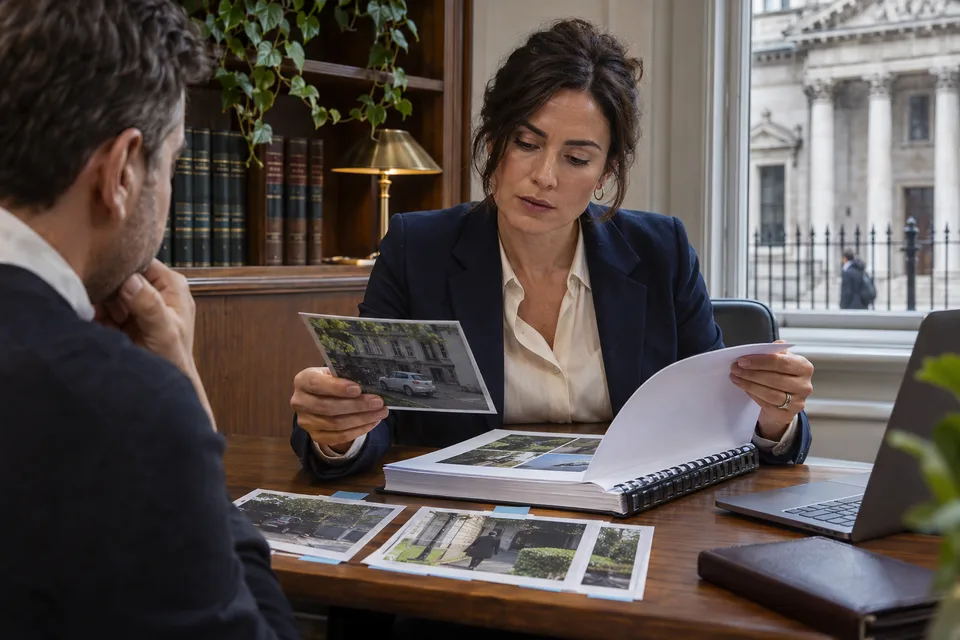
Images can corroborate who was present, where an event occurred and when it happened. They are strongest when paired with contemporaneous notes and an accurate chronology. They should not be cropped or edited in a way that removes necessary context if evidential use is anticipated.
An image of two people together may establish that they met. It does not necessarily prove the nature of the relationship. The report should use neutral language and leave interpretation to the client and, where relevant, the legal team.
| Evidence | May establish | Should not be overstated as |
|---|---|---|
| Two people entering a hotel | A meeting and shared location at a stated time | Automatic proof of sexual activity |
| Repeated overnight presence | A pattern of attendance or apparent cohabitation | A legal conclusion about relationship status |
| Affection observed publicly | A specific observed interaction | Proof of every aspect of the relationship |
| Public social-media posts | Online associations, dates, places or statements | Proof that a private account contains similar material |
| Vehicle movements | Observed travel and parking at locations | Permission to install a tracker |
| Client-provided messages | Conversation lawfully in the client's possession | Authority to access the partner's account or device |
Chronology Is Often More Valuable Than One Photograph
A single image may be ambiguous. A well-documented chronology can show a repeated pattern: departure time, location, meeting, onward movement and return. The value comes from consistency and accurate recording rather than volume.
Professional investigators record negative results too. If the expected meeting does not happen, that belongs in the report. Omitting inconvenient observations reduces reliability.
Open-Source Intelligence Can Corroborate, Not Replace, Observation
Public posts, event information, business records, public profiles and other openly accessible sources can help verify names, locations or timelines. Investigators should distinguish information posted by the subject from material posted by other people and should consider whether old content is being mistaken for current activity.
Our relationship investigations may combine public-source research with physical evidence where each method has a legitimate role.

What About Private Messages?
A private investigator does not gain a legal right to read a partner's WhatsApp, Instagram, email or other private messages. Guessing passwords, bypassing security, installing spyware or cloning accounts can breach criminal and data-protection law.
If the client already lawfully possesses a message — for example, it was sent directly to them — it may be relevant. The investigator can help organise and correlate that evidence, but should not obtain it through unauthorised access.
What About Bank Statements and Financial Records?
Private investigators cannot simply access another person's bank account or confidential financial records. Where the client already has lawful access to joint or personally held financial information, selected transactions may help build a chronology, but legal advice may be needed where financial disclosure is part of formal proceedings.
Do not ask an investigator to obtain protected data through impersonation or deception.
Do Not Install Spyware, Hidden Microphones or Unauthorised Tracking Devices
Infidelity suspicion does not create special surveillance powers. Covert access to private communications, intimate spaces or live location data can create serious legal and safeguarding problems. We aim to explain what cannot lawfully be done.
Vehicle Evidence: Observation Versus Tracking
Observing a vehicle travelling on public roads is different from secretly attaching a tracking device. The ICO-approved ABI code specifically addresses lawful-basis and DPIA questions around covert surveillance and tracking devices, illustrating why GPS use needs its own legal assessment rather than being treated as a routine investigator tool.
In many infidelity cases, conventional observation provides the evidence needed without escalating to a more intrusive technology.
Can Evidence Be Used in Family Proceedings?
Potentially, but the family court controls what evidence is relevant and how it is received. FPR Part 22 gives the court control over evidence, while Part 23 includes rules concerning photographs and other evidence not already contained in witness statements or reports.
If the client expects court use, our legal and litigation support should be coordinated with the solicitor before the investigation so the evidence addresses the right issue and is preserved appropriately.
Children and Safeguarding Change the Priority
Where children are involved, the case should not be framed simply as proving infidelity. Concerns about neglect, unsafe supervision, substance misuse, violence or exposure to risky adults are different factual issues and may require safeguarding advice or police involvement.
Children should not be recruited to gather evidence, question a parent or secretly record conversations. The investigation should minimise their involvement and protect their privacy.
Domestic Abuse, Coercive Control and Stalking Concerns
A request for relationship surveillance may sometimes come from a person seeking to control or locate an ex-partner rather than resolve a legitimate concern. Case screening matters. If an instruction could facilitate harassment, stalking, coercive control or disclosure of a protected location, the investigator should refuse or restrict the work.
The Protection from Harassment Act treats a course of conduct causing alarm or distress as potentially serious, and repeated surveillance can create risk if it crosses lawful boundaries.
A Strong Infidelity Report Is Restrained
It records the subject's movements, people observed, locations, timings and relevant context. It does not use loaded labels or convert suspicion into fact. That makes the report more useful whether the client needs personal clarity or later takes legal advice.
How We Plan an Infidelity Investigation
1. Define the Question
We identify what the client needs to know and why. This might be whether a claimed work trip occurred, whether a particular meeting takes place or whether there is a repeated pattern of overnight absence.
2. Identify the Best Timeframe
Known routines, events and inconsistencies are used to target observation rather than booking unlimited surveillance.
3. Gather Only Necessary Evidence
Observation, images and public-source corroboration are limited to the objective and lawful basis.
4. Preserve Contemporaneous Records
Times, locations, images and negative findings are recorded so the final chronology can be explained.
5. Report Without Overclaiming
We state what was observed and any limitations. Clients can book a confidential consultation to decide whether an investigation is proportionate before committing to operational work.
What Information Helps Before Surveillance Starts?
Infidelity Investigation Briefing Checklist
- full identifying details for the correct subject;
- current photograph and vehicle details where lawfully known;
- normal work and travel routine;
- specific dates or explanations that appear inconsistent;
- known locations relevant to the concern;
- lawfully held messages or documents that establish timing;
- the decision the client is trying to make;
- any solicitor involvement or possible court purpose;
- any safeguarding or domestic-abuse concerns; and
- clear limits on what information is actually necessary.
What Evidence Cannot Tell You
An investigation is a sample of activity during a defined period. A day with no suspicious contact does not prove that nothing has ever happened, just as one ambiguous meeting does not prove an affair. Results must be interpreted within the work covered and time observed.
The most reliable outcome is sometimes certainty that a specific allegation was not evidenced during the investigation. Professional reporting should be comfortable with that result.
Evidence Should Be Planned Around Specific Allegations
“I think my partner is cheating” is understandable as a concern but too broad as an operational instruction. A stronger brief identifies the facts that created suspicion: repeated unexplained Tuesday absences, a claimed work location that does not match routine, regular overnight stays elsewhere or a specific person the client believes is being met.
That allows surveillance to be concentrated on a meaningful window. It also makes the final report easier to interpret because the evidence can be compared with the original explanation rather than judged against a vague expectation that the investigator will uncover “something”.
Evidence of Location Is Not the Same as Evidence of Conduct
Infidelity investigations frequently involve location evidence. Seeing a vehicle outside an address, a person enter a property or two people travel together can be important, but location alone may have many explanations. The report should therefore record duration, timing, repeat patterns and what was actually visible.
Where the client is particularly focused on one address, the investigator should also confirm that the address is correctly identified and avoid assumptions about who lives there based on unverified online information.
Overnight Observation Requires Careful Language
Repeated overnight presence can support a account of the facts of routine, especially in cohabitation-related enquiries. The evidence is strongest when the investigator can document arrival, continued presence where observable and departure the following morning without an unexplained break in coverage.
Even then, the report should avoid turning the observation into a legal conclusion. Whether a pattern amounts to cohabitation for a particular legal or financial purpose is a matter for the client's solicitor and, ultimately, the relevant decision-maker.
Public Affection and Meetings Need Context
Holding hands, embracing or kissing in public may be more probative than simply being seen together, but the investigator should still record the act rather than label the relationship. The same principle applies to meals, shopping, travel and visits to entertainment venues.
Context also prevents misleading snapshots. A photograph taken at the right moment can look more significant than the full sequence. Keeping the surrounding observations in the report makes the evidence more reliable.
What If the Client Already Has Digital Evidence?
Clients may already possess messages, photographs, receipts, calendar entries or shared-account information. The investigator should first establish how the client obtained it and whether they are entitled to provide it. Lawfully held material can then be used to refine the chronology and target further enquiries.
The role is not to “complete” missing digital evidence by breaking into the other person's accounts. Where specialist legal or forensic advice is needed, that should be handled through the appropriate professional rather than improvised within a relationship investigation.
Infidelity Investigations Can Also Disprove a Theory
Suspicion can become self-reinforcing. Every delay, phone notification or routine change may start to look like evidence. Independent surveillance can be valuable precisely because it is capable of producing a neutral result.
If the subject attends the claimed workplace, meets the people they said they would meet and returns when expected, the report should say so. The investigator's value lies in reliable facts, not in validating the client's fear.
Frequently Asked Questions About Evidence in Infidelity Investigations
Answers about surveillance, photographs, private messages, vehicle movements, family-court relevance, privacy and what an investigator can lawfully document.
What Evidence Can a Private Investigator Gather About Suspected Cheating?
Depending on the case, lawful evidence can include public-place observations, photographs or video, a time-stamped chronology, observed vehicle movements, public-source information and client-held material that the client is entitled to provide.
Can a Private Investigator Read My Partner’s WhatsApp Messages?
Not through hacking, password bypass, spyware or other unauthorised access. Messages already lawfully in the client’s possession may be reviewed as part of the chronology.
Can an Investigator Photograph My Partner in Public?
Potentially, where the investigation has a lawful and proportionate purpose. Photography should avoid private spaces and unnecessary intrusion, and the investigator must still consider data-protection and harassment risks.
Does a Hotel Visit Prove Infidelity?
Not by itself. It may establish that two people entered or attended the same location at a particular time. The report should not claim more than the observation supports.
Can a Private Investigator Install a GPS Tracker?
GPS tracking is legally sensitive and requires a separate assessment of authority, lawful basis, ownership, privacy and proportionality. It should never be treated as an automatic tool in relationship investigations.
Can an Investigator Access Bank Statements?
A private investigator has no general right to access another person’s confidential bank records. Financial information should come through lawful client access, disclosure or another authorised legal route.
Do I Need Proof of Adultery to Get Divorced?
No in England and Wales. Since 6 April 2022 the divorce process is no-fault, so adultery evidence is not required simply to obtain a divorce.
Can Infidelity Evidence Be Used in Family Court?
Potentially, if it is relevant to an issue the court must decide and is presented in accordance with the applicable rules. A solicitor should identify the legal relevance before intrusive evidence gathering is commissioned.
Can an Investigator Record Private Conversations?
Secret interception or recording of conversations between other people can raise serious legal issues. A relationship investigation should not rely on hidden microphones or unlawful interception.
How Long Should an Infidelity Surveillance Operation Last?
There is no standard duration. A good plan targets the dates and times most likely to answer the defined question and uses review points rather than assuming longer surveillance is always better.
What If Surveillance Finds Nothing?
That is still a result. It means the suspected activity was not evidenced during the observed period. It does not prove what happened outside the work covered or at another time.
Will the Investigator Confront My Partner?
Normally the purpose of covert fact-finding is to avoid confrontation. Direct contact may change behaviour and compromise the investigation unless it is deliberately part of the agreed method.
Can Evidence Show That Two People Are Cohabiting?
A repeated pattern of overnight presence and routine may be relevant, but “cohabitation” can have legal meanings that an investigator should not decide. The report should present the factual pattern for the client or solicitor to assess.
What If Children Are Involved?
Safeguarding comes first. Children should not be used to gather evidence or placed in the middle of adult suspicions. If the concern is about risk to a child, that should be work coveredd as a safeguarding issue rather than merely infidelity.
What Should I Provide Before an Infidelity Investigation?
Provide accurate identifiers, a recent photograph, known vehicles, routine, specific inconsistencies, important dates, relevant lawfully held messages and the precise question you want the investigation to answer.
Not Sure Where to Start?
Tell us what happened and what you need to establish. We’ll discuss the options before you decide.
BOOK A FREE CONSULTATION