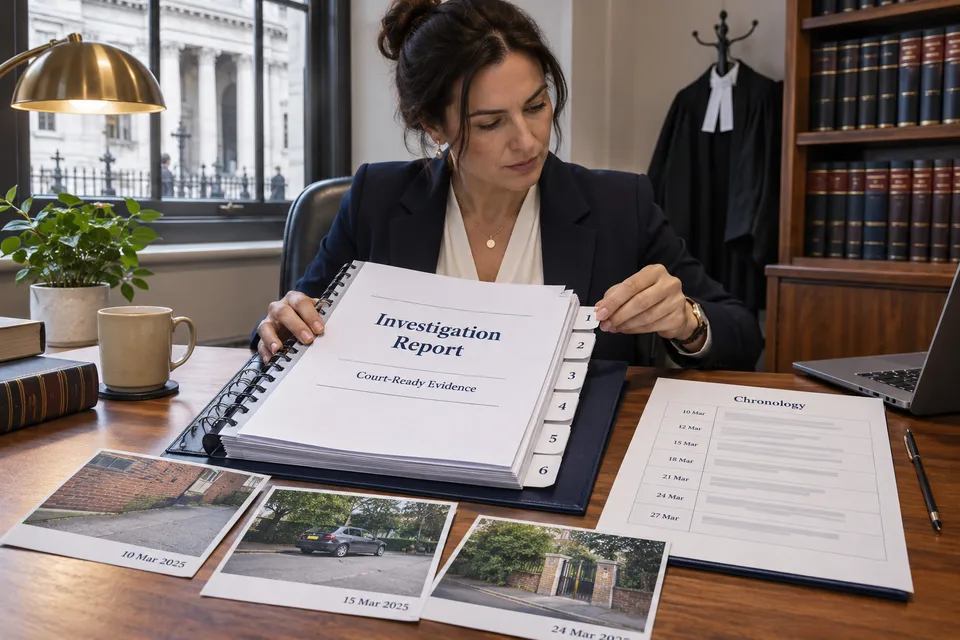
A court-ready private-investigation report should make it possible for a solicitor, party and ultimately a court to understand what the investigator was asked to do, what was actually done, what was observed or obtained, where each item of evidence came from, what the limitations are and how supporting photographs, video or documents can be authenticated. “Court-ready” does not mean automatically admissible and it does not turn a factual investigator into an expert witness.
At Trojan Investigations , we treat litigation reporting as an evidence-management exercise. The report must separate observation from assumption, preserve source source and remain usable if the investigator is later asked to prepare a witness statement or give oral evidence.
What Should a Court-Ready Investigation Report Include?
- the client's or solicitor's instruction and the factual question to be investigated;
- the investigator's identity, role and relevant experience;
- dates, times, locations and the time zone where relevant;
- a clear methodology describing lawful enquiries undertaken;
- a chronological account of observations and findings;
- the source and source of documents, images, video and digital material;
- clear exhibit references and file identifiers;
- facts separated from inference, opinion and client allegation;
- material limitations, gaps and unsuccessful enquiries;
- a record of any significant corrections or amendments;
- secure retention of original evidence; and
- where required, a separate witness statement prepared in the correct procedural form.
The report should be written so another person can follow the evidential trail without having to guess how a conclusion was reached.
CPR 32 gives the civil court power to control evidence and sets the general framework for witness evidence. PD 32 sets detailed requirements for witness statements, exhibits and statements of truth. CPR 35 is the separate regime for expert evidence; a factual investigator is not automatically an expert witness.“court-Ready” Is Not a Legal Status
The phrase is useful shorthand, but there is no certificate that makes an investigator's report admissible merely because it is labelled court-ready. The court decides what evidence it requires and may exclude evidence that would otherwise be admissible. The solicitor should therefore define the legal purpose before the investigation is designed.
Our legal and litigation services work starts with that distinction. A report for pre-action fact finding may look different from a witness statement for trial, an exhibit schedule for a hearing or a report that will support an employment, family or commercial process.

Report, Witness Statement and Expert Report Are Different Documents
| Document | Primary purpose | Key point |
|---|---|---|
| Investigation report | Explains instructions, work undertaken, evidence and findings | Useful for case assessment but not automatically a formal witness statement |
| Witness statement | Sets out factual evidence the witness could give orally | Must comply with the applicable procedural requirements and statement of truth |
| Expert report | Provides independent expert opinion on matters requiring expertise | Governed by CPR Part 35 in civil proceedings and carries a duty to the court |
The Instruction Should Be Recorded Clearly
A strong report begins by stating what the investigator was asked to establish. “Investigate Mr X” is too broad. “Establish whether the vehicle registered AB12 CDE attended Location Y between 18:00 and 22:00 on 12 September” is testable and allows the reader to understand why particular enquiries were proportionate.
If the instruction changes, that should also be recorded. Mission creep creates unnecessary material and can make it difficult to explain why personal information was collected.
Chronology Is Usually the Backbone of the Report
Operational evidence is most useful when events are set out in time order with consistent timestamps. Surveillance logs should identify when observation began, when visual contact was established or lost, locations, relevant movements and when photographs or video were captured.
Our surveillance services use contemporaneous notes and time-referenced media so a later report is based on records made during the operation rather than reconstructed memory.
Every Material Item Needs Provenance
A screenshot is not self-explanatory. The report should say who supplied it, when it was received, whether it is the original file or a copy, what account or device it came from and whether any conversion or compression occurred. The same principle applies to documents, social-media captures, CCTV, emails and photographs.
For digital evidence, retaining original files and recording file names, dates and handling steps is often more useful than repeatedly resaving material into different formats.
Evidence-Handling Details That Improve Report Quality
- Use consistent date and time formats.
- Identify the source of every important document or image.
- Keep original files separately from working copies.
- Number exhibits consistently.
- Record when evidence was received and by whom.
- Do not overwrite originals with annotated versions.
- Describe any cropping, conversion or enhancement.
- Keep a clear index of video and photograph files.
- Record gaps in observation rather than implying continuous coverage.
- Preserve relevant notes even if they do not support the client's preferred theory.
Facts, Inferences and Client Allegations Must Be Separated
“The subject entered 14 King Street at 19:42” is an observation. “The subject was meeting a secret business partner” may be an inference unless there is evidence of the person's identity and purpose. “The client believes the subject is diverting stock” is an allegation that explains the instruction but is not an investigative finding.
A court-ready report labels those categories correctly. Overstating inference as fact can damage the credibility of otherwise strong evidence.
Include Evidence That Does Not Support the Theory
An investigator's role is not to manufacture a case. If a surveillance session shows no relevant activity, the report should say so. If a record contradicts the client's allegation, that should be identified. In civil proceedings, disclosure obligations can extend beyond documents that help a party's case, so selective preservation is a poor litigation strategy.
CPR Part 31 defines documents broadly and, where standard disclosure applies, can require disclosure of documents that adversely affect a party's own case or support another party's case. The solicitor controls the disclosure strategy; the investigator should not destroy inconvenient material.
Do Not Ask an Investigator to “clean Up” the Evidence
Removing failed surveillance periods, contrary observations or awkward documents because they do not help the client can create serious evidential and credibility problems. A professional report records what happened, including uncertainty and negative findings.
Witness Statements Need Their Own Procedural Treatment
CPR 32 describes a witness statement as a signed written statement containing the evidence the person would be allowed to give orally. Practice Direction 32 sets detailed requirements for headings, numbered paragraphs, exhibits and the statement of truth.
An investigation report can be a source document from which a witness statement is later prepared, but the two should not be assumed to be interchangeable. The solicitor should decide what statement is needed and from whom.
An Investigator Is Not Automatically an Expert
Factual Evidence and Expert Opinion Have Different Rules
CPR Part 35 applies to expert evidence. Experts have an overriding duty to help the court within their expertise and must remain independent. A private investigator who reports what they saw, did or obtained is generally providing factual evidence. If expert opinion is genuinely required, it should be instructed and prepared under the applicable expert-evidence regime.
Photographs and Video Need Context
A still image may be accurate but misleading if separated from the sequence around it. Reports should therefore state when and where imagery was captured, what device or operative captured it and how it relates to the written log. Where an image has been enlarged or cropped for readability, the original should be retained.
Video is similarly stronger when there is a clear index showing relevant timecodes rather than asking a solicitor to review hours of footage without explanation.
Limitations Belong in the Report
No investigation is complete in the absolute sense. A subject may leave by an unseen exit, a company register may not reveal beneficial arrangements, an online profile may be false and an observer can lose contact in traffic. Those limitations should be stated, not hidden.
Qualified language such as “we observed”, “the public record showed”, “we were unable to verify” and “this is consistent with” is often more defensible than absolute claims the evidence cannot support.
How We Build a Litigation-Support Report
1. Define the Legal Question
We ask what fact the solicitor or client needs established and why it matters to the proceeding.
2. Design the Evidence Plan
We identify proportionate lawful methods, likely exhibits and any evidence that must be preserved before it changes.
3. Record Operational Activity Contemporaneously
Notes, timestamps, media and source records are created or preserved while the work is being done.
4. Reconcile the Evidence
We compare chronology, documents, images and other findings and mark conflicts or gaps rather than forcing them into one story.
5. Deliver the Report and Supporting Evidence
Our business investigation services can produce structured factual reporting for corporate disputes as well as other case types, with any later witness-statement requirement coordinated with the legal team.
What Makes a Report Useful to a Solicitor?
Useful reporting is concise enough to navigate but detailed enough to audit. A solicitor should be able to identify the key finding, jump to the supporting exhibit, understand where it came from and see any limitation without telephoning the investigator to reconstruct the basics.
If a matter is likely to reach proceedings, early coordination saves cost. Clients can book a confidential consultation so the work covered, evidence format and reporting requirements are agreed before operational work starts.
A Credible Report Is Transparent About What It Cannot Prove
Courts and solicitors do not need certainty where the evidence does not provide it. They need an accurate account of what was observed, how evidence was obtained and where the boundaries of the investigation lie.
The Report Should Preserve Original Digital Evidence, Not Just a Pdf Summary
A well-written PDF can explain the findings, but it should not become the only surviving form of the evidence. Original photographs, video files, exported messages, emails and documents may contain information that is lost when material is pasted into a report. Where those originals are relevant, they should be retained securely with consistent file names or exhibit references.
The report can then use thumbnails, stills or extracts for readability while directing the reader to the underlying file. This reduces the risk that an enlarged screenshot or compressed video is mistaken for the source item.
Version Control Matters When a Report Is Corrected
Investigative reports can require amendments after a spelling error, incorrect time, new evidence or clarification is identified. Corrections should not silently overwrite the record. A clear version number or amendment note allows the legal team to know which report is current and what changed.
If a material factual error is discovered after a witness statement has been signed or evidence has been served, the investigator should inform the instructing solicitor promptly rather than attempting to fix the issue informally. Transparency about an honest correction is usually more defensible than leaving inconsistent versions in circulation.
Who Can Authenticate the Evidence?
A report should identify the person capable of explaining important evidence if it is challenged. An operative can usually speak to what they personally observed and recorded. A client may need to explain a message export they supplied. A company employee may need to explain an internal log. A forensic specialist may be required for technical analysis outside the investigator's competence.
This is why collecting anonymous screenshots with no source history is weak practice. The legal team needs to know not only what the item shows but who can establish where it came from.
Hearsay and Documentary Evidence Need Legal Review
Investigators often receive information from witnesses who are not yet providing formal statements. The report should attribute what each person said and distinguish it from direct observation. Whether that material is later relied upon as hearsay, converted into a witness statement or excluded is a legal and procedural decision.
The investigator should not rewrite second-hand information as personal knowledge. Phrases such as “the witness told me” or “the client supplied” protect the integrity of the evidential chain.
Different Courts and Tribunals Can Require Different Formats
The Civil Procedure Rules discussed in this guide are central to civil litigation in England and Wales, but family proceedings, employment tribunals, criminal cases and courts in Scotland or Northern Ireland have their own procedures. A report that is excellent for an insurer's civil claim may need different supporting documents for another forum.
“Court-ready” therefore means prepared for the intended proceeding, not produced from a universal template. The investigator should ask which jurisdiction, court or tribunal is involved and whether a solicitor has given specific directions.
Reports Should Distinguish Absence of Evidence from Evidence of Absence
If surveillance did not observe a person leaving a building, that does not prove they remained inside unless every possible exit was covered. If public-source checks did not find a company connection, that does not prove none exists. If a search produced no matching social profile, it may mean the account is private, renamed or absent.
Careful wording is one of the clearest differences between a professional evidential report and an advocacy document. The report should say what the enquiries establish, not what the client hopes they establish.
Frequently Asked Questions About Court-Ready Investigation Reports
Answers about investigation reports, witness statements, exhibits, digital evidence, expert evidence, disclosure and preparing findings for UK proceedings.
What Does “court-Ready” Mean for a Private Investigator Report?
It normally means the report is structured, evidence-led, transparent about source and limitations, and capable of supporting legal review. It does not mean the court is required to admit or accept every part of it.
Is an Investigation Report the Same as a Witness Statement?
No. A witness statement is a formal document containing evidence the witness could give orally and must comply with the relevant procedural requirements. An investigation report may be used to prepare one later.
Does Every Report Need a Statement of Truth?
Not every internal investigation report does. A formal witness statement and certain other court documents require the appropriate statement of truth. The solicitor should specify the required document.
Can a Private Investigator Give Expert Evidence?
Only where expert evidence is genuinely required and the person is properly qualified and instructed under the applicable rules. Ordinary surveillance and investigative findings are usually factual evidence, not expert opinion.
Should Failed Surveillance Be Included in the Report?
Yes when relevant to the work covered. A report should not imply continuous or successful observation if visual contact was lost or nothing relevant occurred.
How Should Photographs Be Presented?
They should be linked to a date, time, location and observation where possible, with original files retained. Cropped or enlarged copies can be used for readability if the original is preserved.
Can Screenshots Be Used as Evidence?
Potentially, but source and context matter. Record who captured or supplied the screenshot, when it was obtained and what account or device it relates to.
What Is Chain of Custody?
It is the record of how evidence was obtained, transferred, stored and handled. The level of formality depends on the case, but a clear handling history improves reliability.
Should the Report Contain Opinions?
A factual investigator should avoid presenting unsupported opinions as fact. Any inference should be clearly labelled and grounded in the evidence. Expert opinion is governed by separate rules.
What If Evidence Contradicts the Client’s Allegation?
It should be reported. An investigator is there to establish facts, not to create a one-sided narrative.
Can an Investigator Prepare Exhibits?
Yes, factual reports and witness statements can refer to properly identified exhibits. The precise exhibit format should be agreed with the solicitor for the proceedings.
Does the Investigator Need to Attend Court?
Sometimes. A witness may be required for cross-examination or to explain factual evidence. Attendance and preparation should be discussed and costed separately.
Can a Court Exclude Evidence Gathered by a Private Investigator?
Yes. Courts control evidence and can exclude material or limit the issues and manner in which evidence is presented. Relevance, fairness, authenticity and procedural compliance can all matter.
How Early Should a Solicitor Be Involved?
As early as practical when litigation is anticipated. Designing the investigation around the actual legal issue can prevent wasted work and improve evidential usefulness.
What Should I Provide Before Commissioning a Court-Focused Investigation?
Provide the pleadings or dispute summary if available, the factual issues to be proved, relevant deadlines, existing evidence, known witnesses and the solicitor’s preferred reporting or statement format.
Not Sure Where to Start?
Tell us what happened and what you need to establish. We’ll discuss the options before you decide.
BOOK A FREE CONSULTATION